

The Bureau of Customs (BOC) has rolled out a major policy reform extending the validity of importer accreditation from one year to three years, alongside reduced fees, in a move aimed at easing business processes and strengthening trade facilitation.
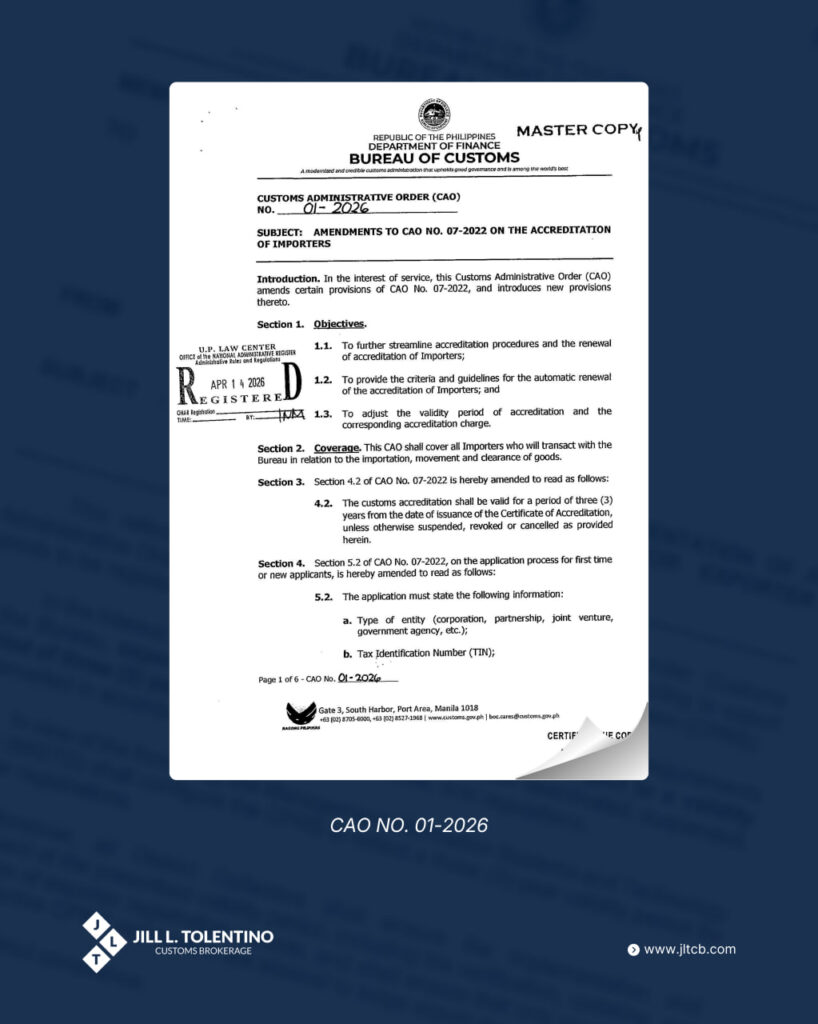
The reform was formalized through Customs Administrative Order (CAO) No. 01-2026, signed by Finance Secretary Frederick D. Go and implemented under BOC Commissioner Ariel F. Nepomuceno. It amends provisions of CAO No. 07-2022, which previously required importers to renew accreditation annually.
Under the updated policy, accreditation is now valid for three years, replacing the earlier one-year cycle that required repeated submissions and compliance procedures. The BOC also reduced the accreditation cost to a one-time payment of ₱5,000 for the entire three-year period, down from ₱2,000 annually or ₱6,000 over the same duration.
Officials say the reform is part of broader efforts to streamline government processes and improve the ease of doing business in the Philippines. According to the BOC, the previous system imposed administrative burdens on importers, including frequent renewals, redundant documentation, and higher compliance costs.
“By extending the validity of importer accreditation, we are reducing red tape and enabling a more efficient trade system,” Go said, noting that the change allows businesses to focus more on operations and growth rather than regulatory requirements.
The measure also aligns with the directive of Ferdinand R. Marcos Jr. to enhance trade competitiveness and improve public service delivery across government agencies.
Despite the extended validity, importers are still required to submit an Annual Reportorial Compliance (ARC) within 30 days of their accreditation anniversary to ensure records remain updated and compliant with regulations.
The new rules also introduce incentives for compliant businesses. Importers with at least six consecutive years of good standing, or those under programs such as the Authorized Economic Operator (AEO), may qualify for automatic renewal of their accreditation.
Business organizations have welcomed the reform, citing its potential to reduce administrative barriers and improve the country’s investment climate. The European Chamber of Commerce of the Philippines described the policy as a step toward a more transparent, efficient, and competitive trade environment.
Industry groups added that the longer validity period allows companies to plan operations with greater certainty while lowering compliance costs, making the Philippines more attractive to investors.
Exporter registration aligned
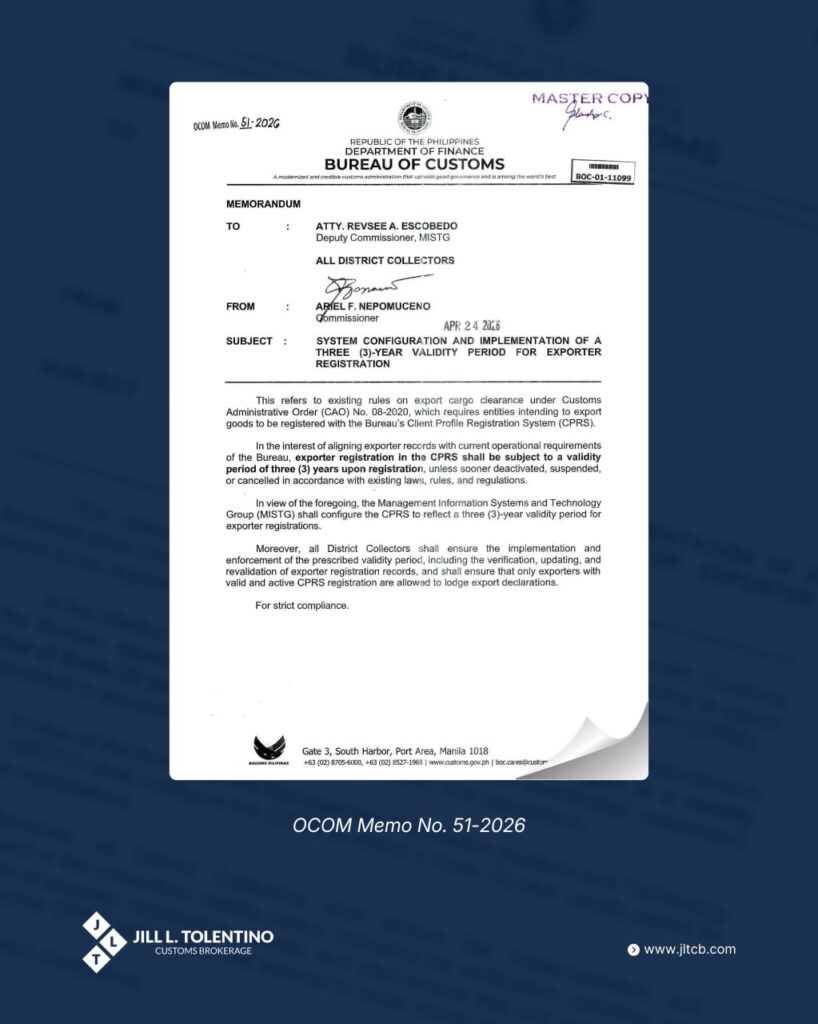
In a parallel development, the BOC has also extended the validity of exporter registration under its Client Profile Registration System (CPRS) from one year to three years.
Through Office of the Commissioner (OCOM) Memo No. 51-2026 dated April 24, Nepomuceno directed the agency’s Management Information Systems and Technology Group to update the CPRS to reflect the new validity period, unless registrations are earlier suspended, cancelled, or deactivated under existing laws.
The memo emphasized that the change is intended to align exporter records with current operational requirements. Under CAO No. 08-2020, exporters are required to register with the CPRS before they can process export declarations or secure certificates and proofs of origin.
The accreditation reform forms part of the BOC’s wider modernization agenda focused on improving efficiency, strengthening data integrity, and minimizing opportunities for corruption. It also complements parallel initiatives, such as aligning exporter registration validity to the same three-year period within the agency’s systems.
By aligning importer accreditation and exporter registration to a three-year cycle, the BOC aims to strike a balance between facilitating trade and maintaining regulatory oversight, ensuring that legitimate businesses benefit from streamlined processes while compliance standards remain firmly enforced.
RELATED ARTICLES
- 27/04/2026
- JLTCB
Complete Guide to Permits, Licenses, and Government Accreditations in the Philippines
- 22/04/2026
- Janelle
How JLTCB Is Quietly Reshaping Solar Imports on World Earth Day
- 16/04/2026
- JLTCB
Breaking the Bottleneck: How Industry and Government Are Rewiring Philippine Trade Flow
- 15/04/2026
- JLTCB
JLTCB Leads DTI-Bataan Seminar on Export Essentials, Equipping First-Time Exporters for Global Trade
SHARE
READ MORE ARTICLES
- 27/04/2026
- JLTCB
Complete Guide to Permits, Licenses, and Government Accreditations in the Philippines
- 22/04/2026
- Janelle
How JLTCB Is Quietly Reshaping Solar Imports on World Earth Day
- 16/04/2026
- JLTCB
Breaking the Bottleneck: How Industry and Government Are Rewiring Philippine Trade Flow


